
Honeycomb Performance
Advantages of Honeycomb
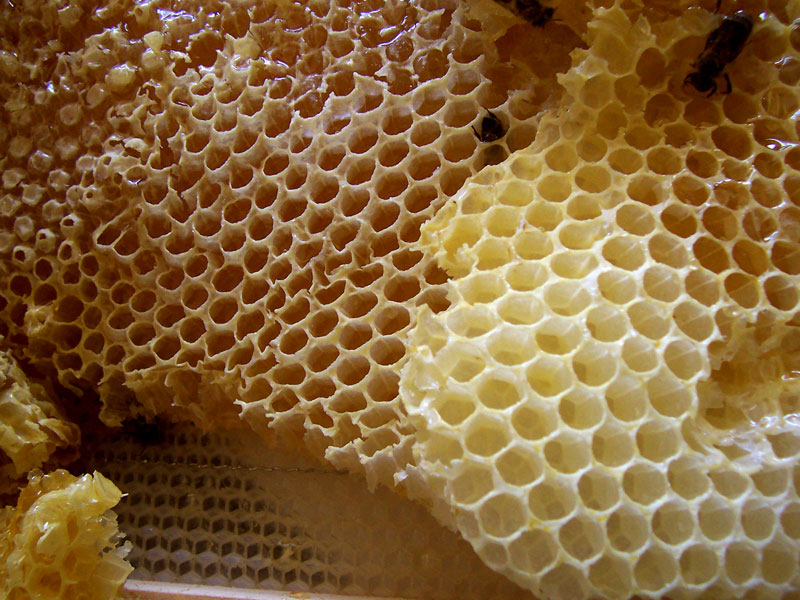
THE CORE
A heavy 991b. kraft paper is bonded together into I’ wide hexagonal cells creating a honeycomb core. The core is impregnated with just the right amount of phenolic resin to rest mildew and vermin, but not too much to create a brittle condition.
THE LAMINATING PROCESS
The door panels are thoroughly cleaned and phosphatized and a tough contact adhesive is applied to the inside faces completely coating the surfaces. The honeycomb core is resin-impregnated, sanded to ensure uniform thickness, and contact adhesive is applied to the surfaces. The honeycomb core and the door panels are assembled together. An ultimate bond is achieved between the honeycomb core and the door panels through a set of high-pressure pinch rolls. The laminating process is complete.
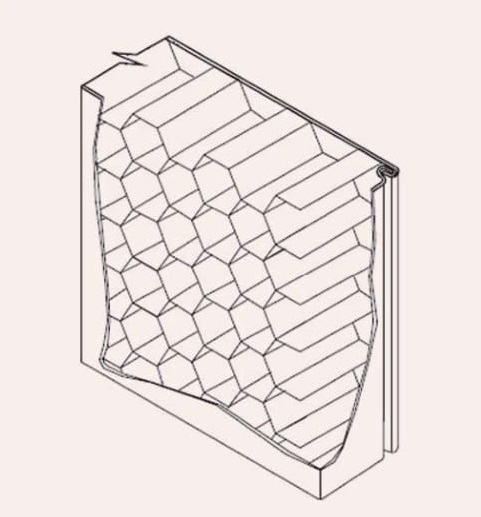
TWIST (IMPACT) TEST:
Twist and impact tests demonstrate that honeycomb core doors will take abuse and punishment even in extreme conditions. Twist tests were conducted by clamping three corners of a door securely in place and applying weights totaling 450 lbs. to the fourth corner.
Test Results - After 450 lbs.
| Door Tested | Average Deflection Under Load | Average Residual Deflection | ||
|---|---|---|---|---|
| Corner | Diagonal | Corner | Diagonal | |
| L20 x 1-3/4″ | .552 | .170 | .015 | .006 |
COMPARISON DATA:
Many different cores are used indoors Three (3) comparisons illustrate the superiority of the honeycomb core.
| Material | Shear | Compression | Maximum Service Temp | |
|---|---|---|---|---|
| Steel door honeycomb core | 28 PSI | 5000 PSF | 400°F | |
| Steel door polystyrene core | 18 PSI | 1750 PSF | 165° F | |
| Steel door urethane core | 23 PSI | 3600 PSF | 200° F | |
| Steel door steel stiffened | N A | 5700 PSF | 400° F |